CD Mapping & Control
Paper Machine Cross-Direction Control
PRBS Identification • Adaptive Shrinkage • MPC Control
Vremsoft
System Architecture
Two-process architecture over ZeroMQ REQ/REP
automap4.py: REP controller — S-curve discovery, PRBS, MPC control
machinedriver.py: site bridge to real paper machine (STEC/Multiverse)
modelstdcom.py: lab paper-machine simulator (replaces deprecated modeldriver.py)
automap4 discovers everything from setpoints + observed profiles
S-curve / mapping, transport delay, gain, response width
Hard-gated commissioning order: S-curve discovery → PRBS → control
Message schema identical for simulator and live machine
Mapping Matrix G[i,j]
- N_act × N_box matrix (96 × 500 default)
- Each row = actuator response profile
- Row sum = 1.0 (area-normalised)
- Process gain recovered separately:
gain = √(2π) × σ
- Negative gain for dilution actuators
(opening valve decreases basis weight)
- Initial mapping: fallback S-curve + Gaussians
G[i,j] = response of actuator i at databox j
PRBS Identification
- Pseudo-Random Binary Sequence
- Values: {-1, 0, +1}
- Probabilities: P(-1)=0.25, P(0)=0.5, P(+1)=0.25
- Sequence length: 511 per actuator
- All 96 zones excited simultaneously
- Amplitude: 3% of full stroke (configurable 1-20%)
- Uncorrelated excitation across actuators
- Learning rate α = 0.05 (PRBS)
u(t) = clamp(50 + A × PRBS(t), 0, 100)
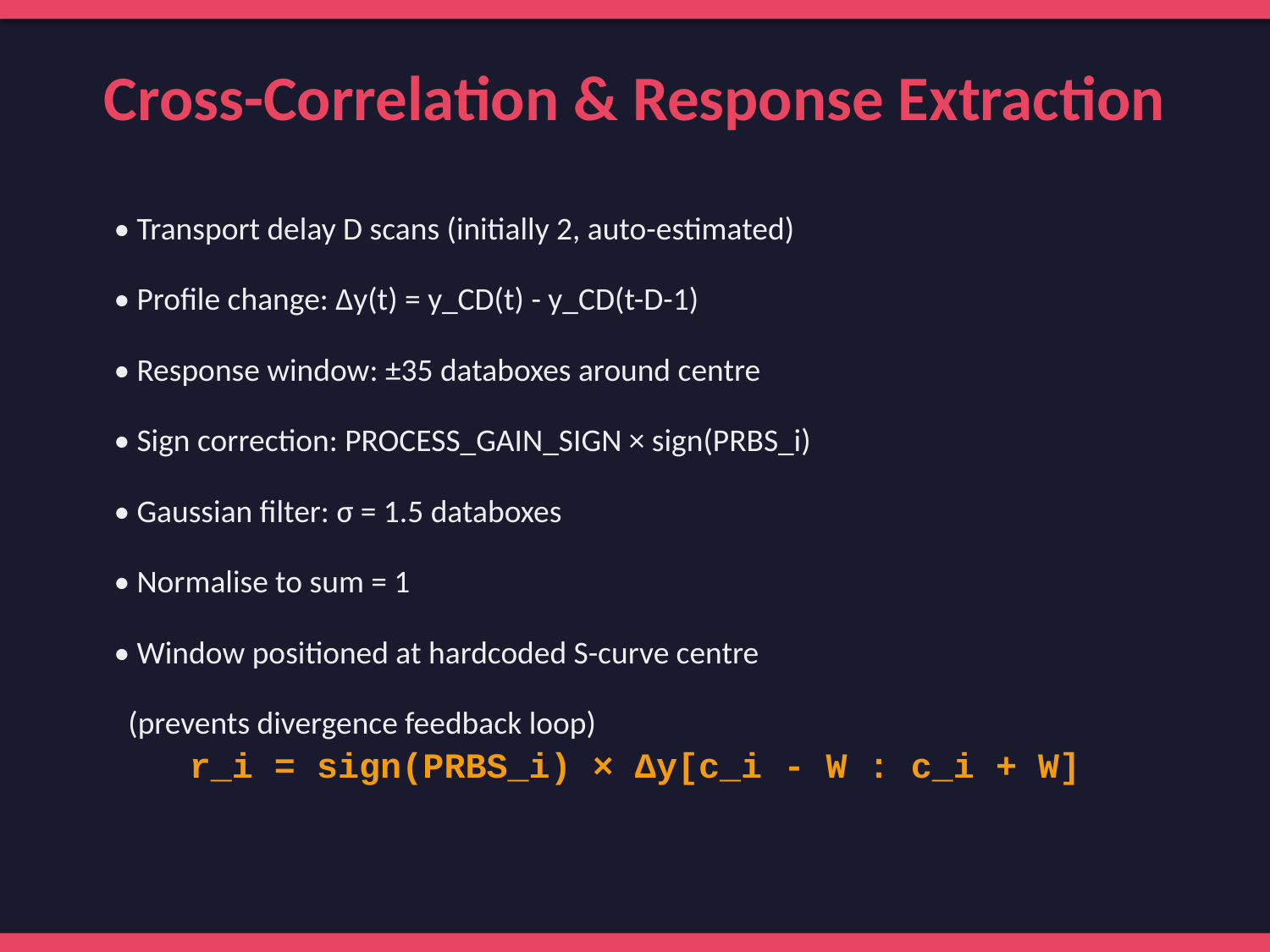
Cross-Correlation & Response Extraction
- Transport delay D scans (initially 2, auto-estimated)
- Profile change: Δy(t) = y_CD(t) - y_CD(t-D-1)
- Response window: ±35 databoxes around centre
- Sign correction: PROCESS_GAIN_SIGN × sign(PRBS_i)
- Gaussian filter: σ = 1.5 databoxes
- Normalise to sum = 1
- Window positioned at hardcoded S-curve centre
(prevents divergence feedback loop)
r_i = sign(PRBS_i) × Δy[c_i - W : c_i + W]
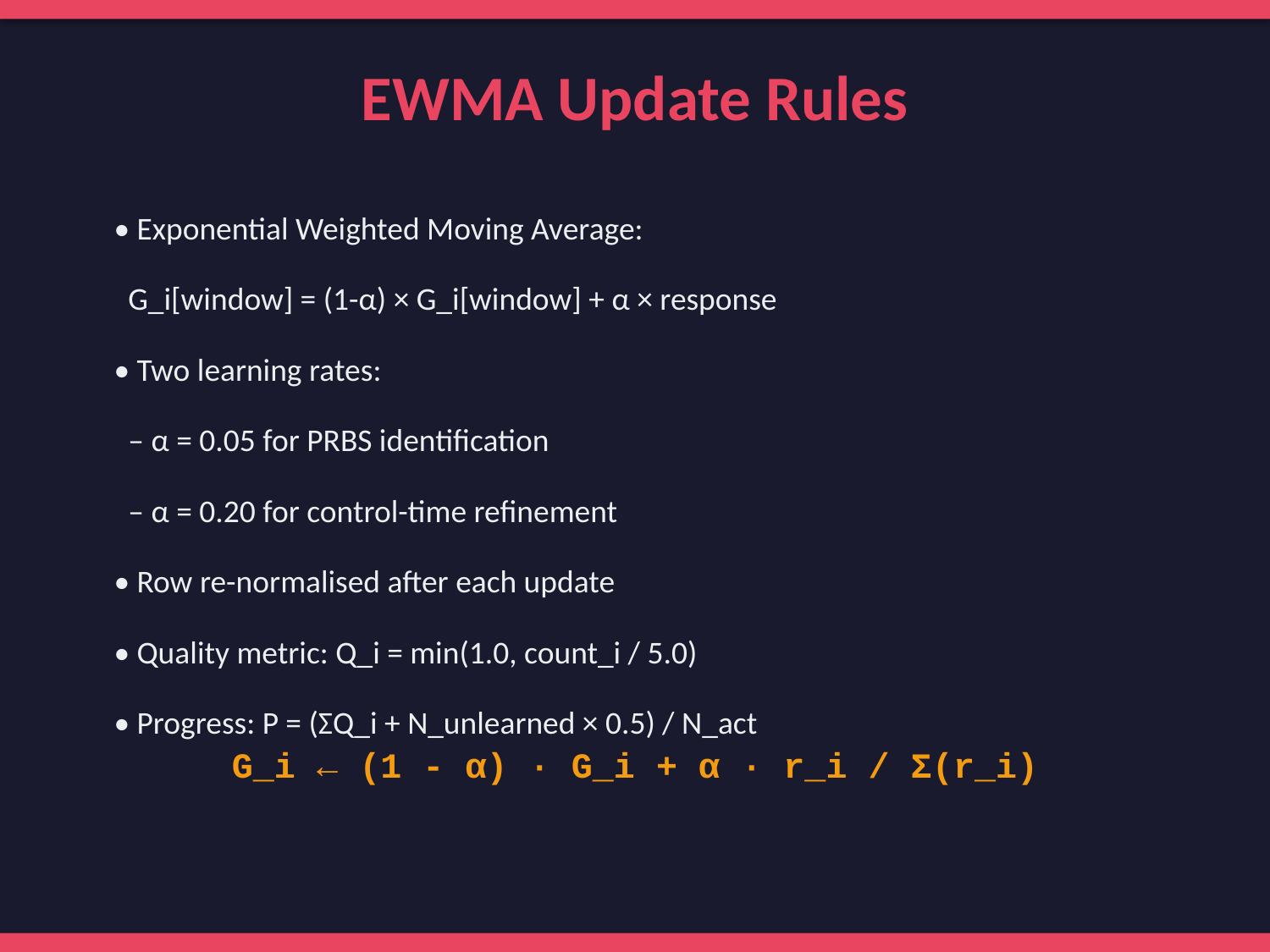
EWMA Update Rules
- Exponential Weighted Moving Average:
G_i[window] = (1-α) × G_i[window] + α × response
- Two learning rates:
- α = 0.05 for PRBS identification
- α = 0.20 for control-time refinement
- Row re-normalised after each update
- Quality metric: Q_i = min(1.0, count_i / 5.0)
- Progress: P = (ΣQ_i + N_unlearned × 0.5) / N_act
G_i ← (1 - α) · G_i + α · r_i / Σ(r_i)
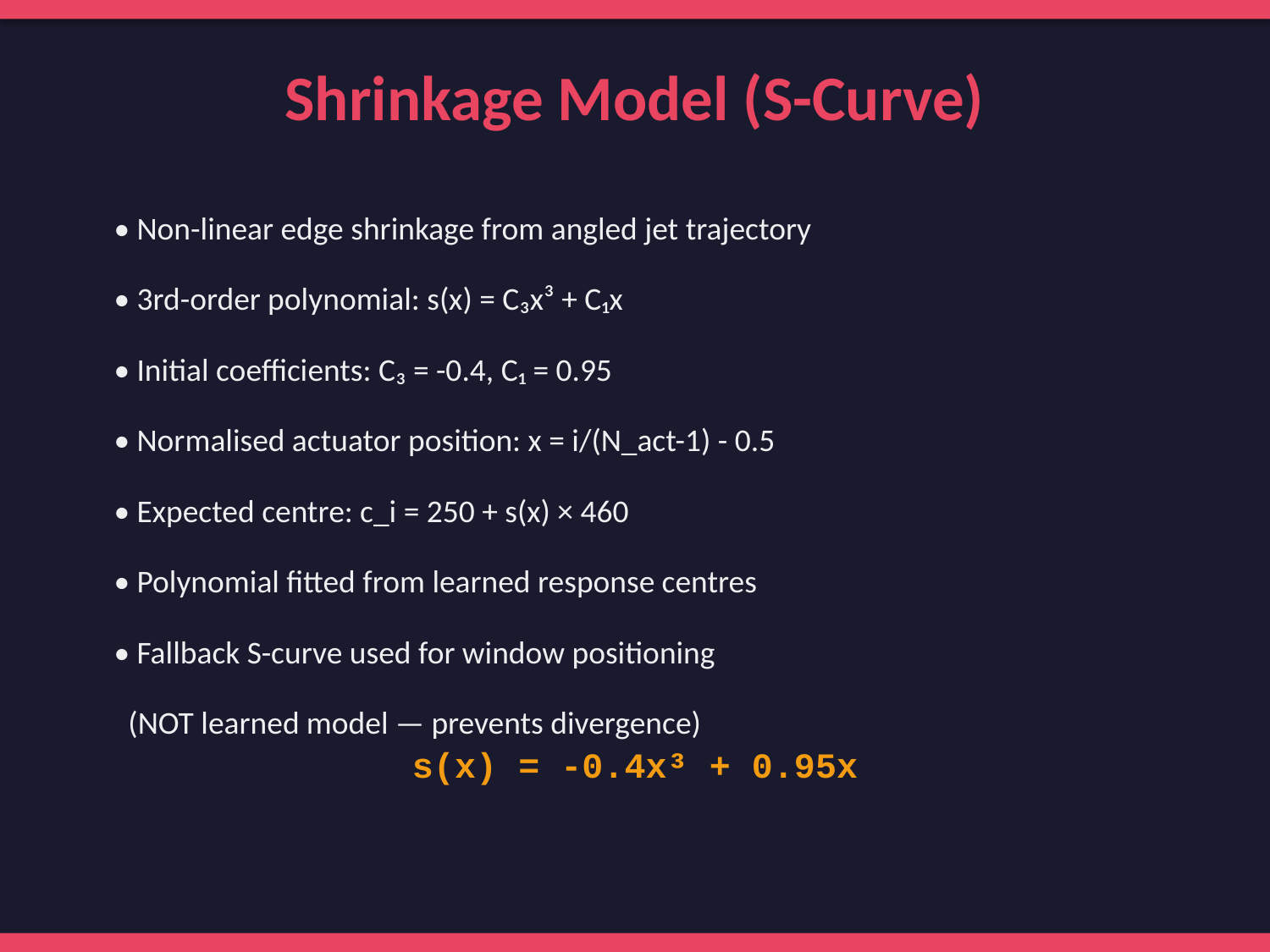
Shrinkage Model (S-Curve)
- Non-linear edge shrinkage from angled jet trajectory
- 3rd-order polynomial: s(x) = C₃x³ + C₁x
- Initial coefficients: C₃ = -0.4, C₁ = 0.95
- Normalised actuator position: x = i/(N_act-1) - 0.5
- Expected centre: c_i = 250 + s(x) × 460
- Polynomial fitted from learned response centres
- Fallback S-curve used for window positioning
(NOT learned model — prevents divergence)
s(x) = -0.4x³ + 0.95x
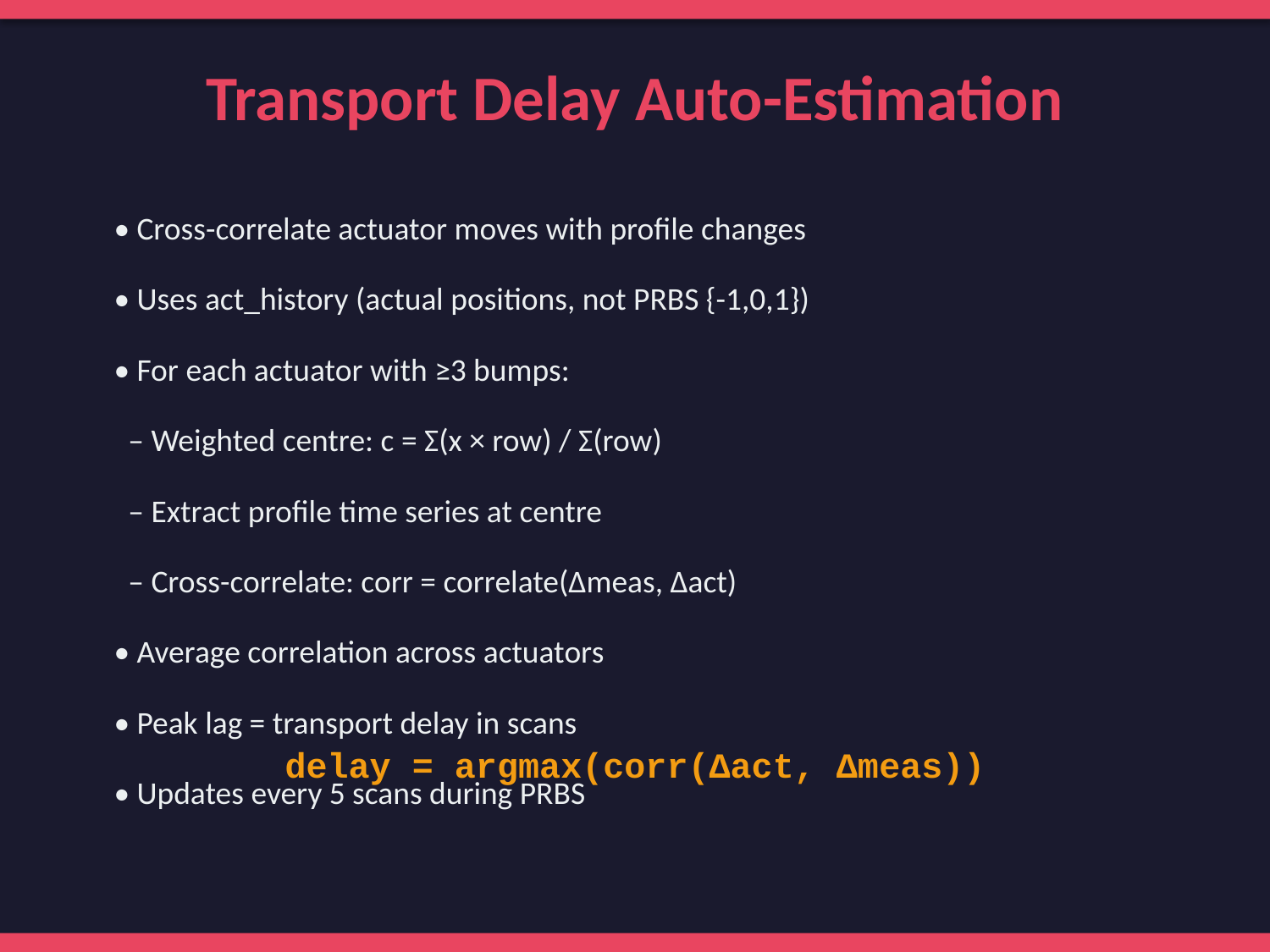
Transport Delay Auto-Estimation
- Cross-correlate actuator moves with profile changes
- Uses act_history (actual positions, not PRBS {-1,0,1})
- For each actuator with ≥3 bumps:
- Weighted centre: c = Σ(x × row) / Σ(row)
- Extract profile time series at centre
- Cross-correlate: corr = correlate(Δmeas, Δact)
- Average correlation across actuators
- Peak lag = transport delay in scans
- Updates every 5 scans during PRBS
delay = argmax(corr(Δact, Δmeas))
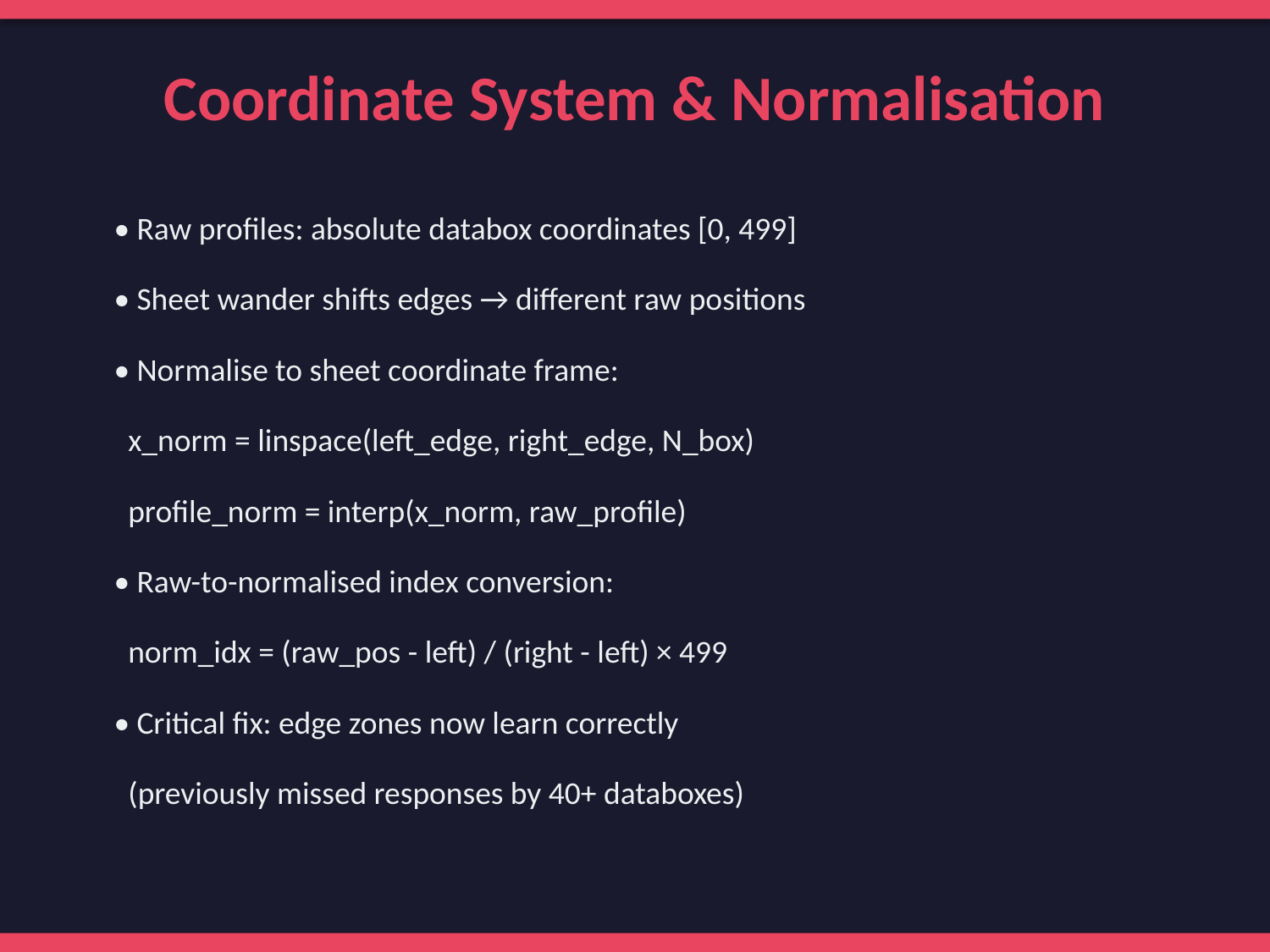
Coordinate System & Normalisation
- Raw profiles: absolute databox coordinates [0, 499]
- Sheet wander shifts edges → different raw positions
- Normalise to sheet coordinate frame:
x_norm = linspace(left_edge, right_edge, N_box)
profile_norm = interp(x_norm, raw_profile)
- Raw-to-normalised index conversion:
norm_idx = (raw_pos - left) / (right - left) × 499
- Critical fix: edge zones now learn correctly
(previously missed responses by 40+ databoxes)
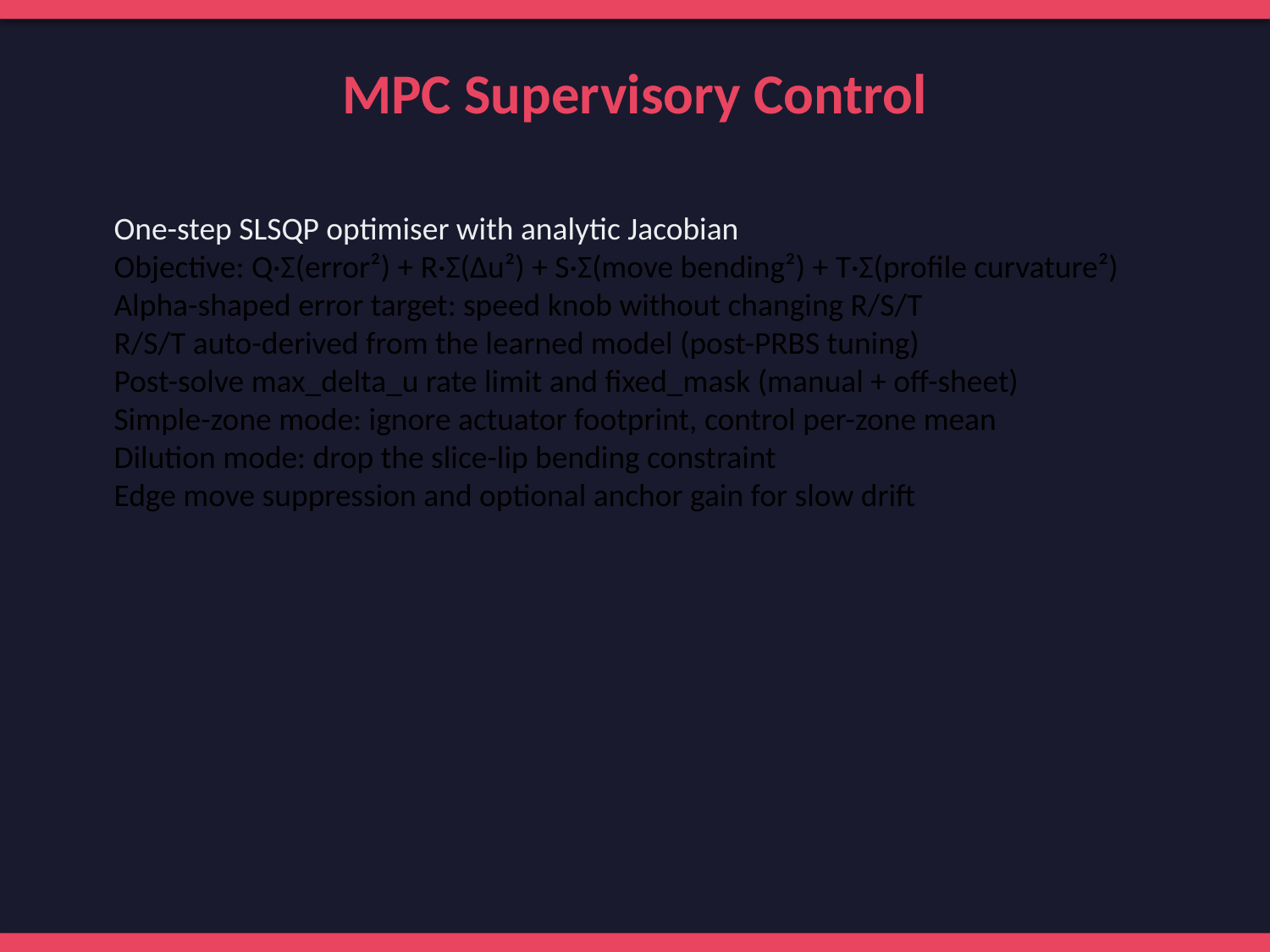
MPC Supervisory Control
One-step SLSQP optimiser with analytic Jacobian
Objective: Q·Σ(error²) + R·Σ(Δu²) + S·Σ(move bending²) + T·Σ(profile curvature²)
Alpha-shaped error target: speed knob without changing R/S/T
R/S/T auto-derived from the learned model (post-PRBS tuning)
Post-solve max_delta_u rate limit and fixed_mask (manual + off-sheet)
Simple-zone mode: ignore actuator footprint, control per-zone mean
Dilution mode: drop the slice-lip bending constraint
Edge move suppression and optional anchor gain for slow drift
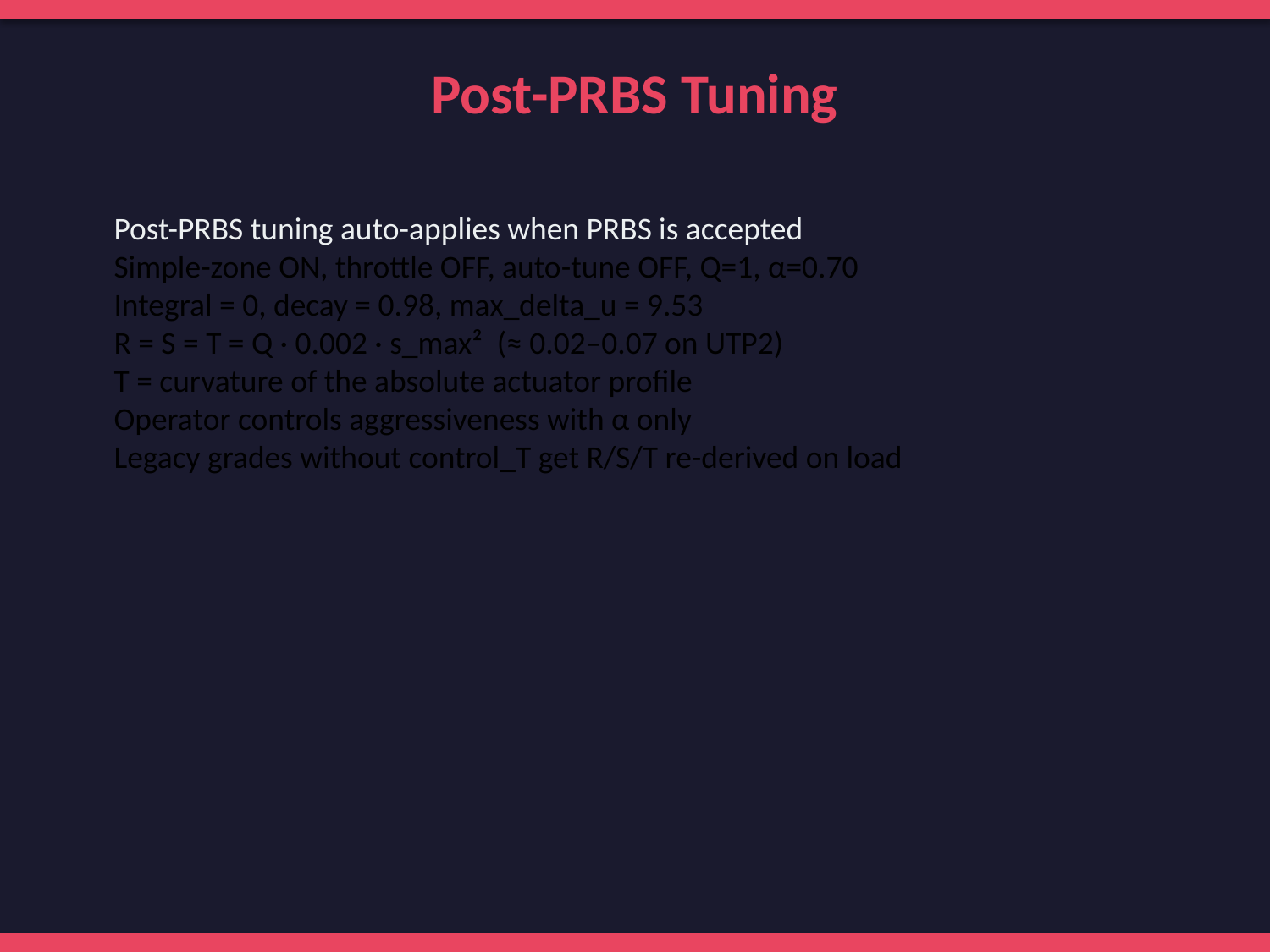
Post-PRBS Tuning
Post-PRBS tuning auto-applies when PRBS is accepted
Simple-zone ON, throttle OFF, auto-tune OFF, Q=1, α=0.70
Integral = 0, decay = 0.98, max_delta_u = 9.53
R = S = T = Q · 0.002 · s_max² (≈ 0.02–0.07 on UTP2)
T = curvature of the absolute actuator profile
Operator controls aggressiveness with α only
Legacy grades without control_T get R/S/T re-derived on load
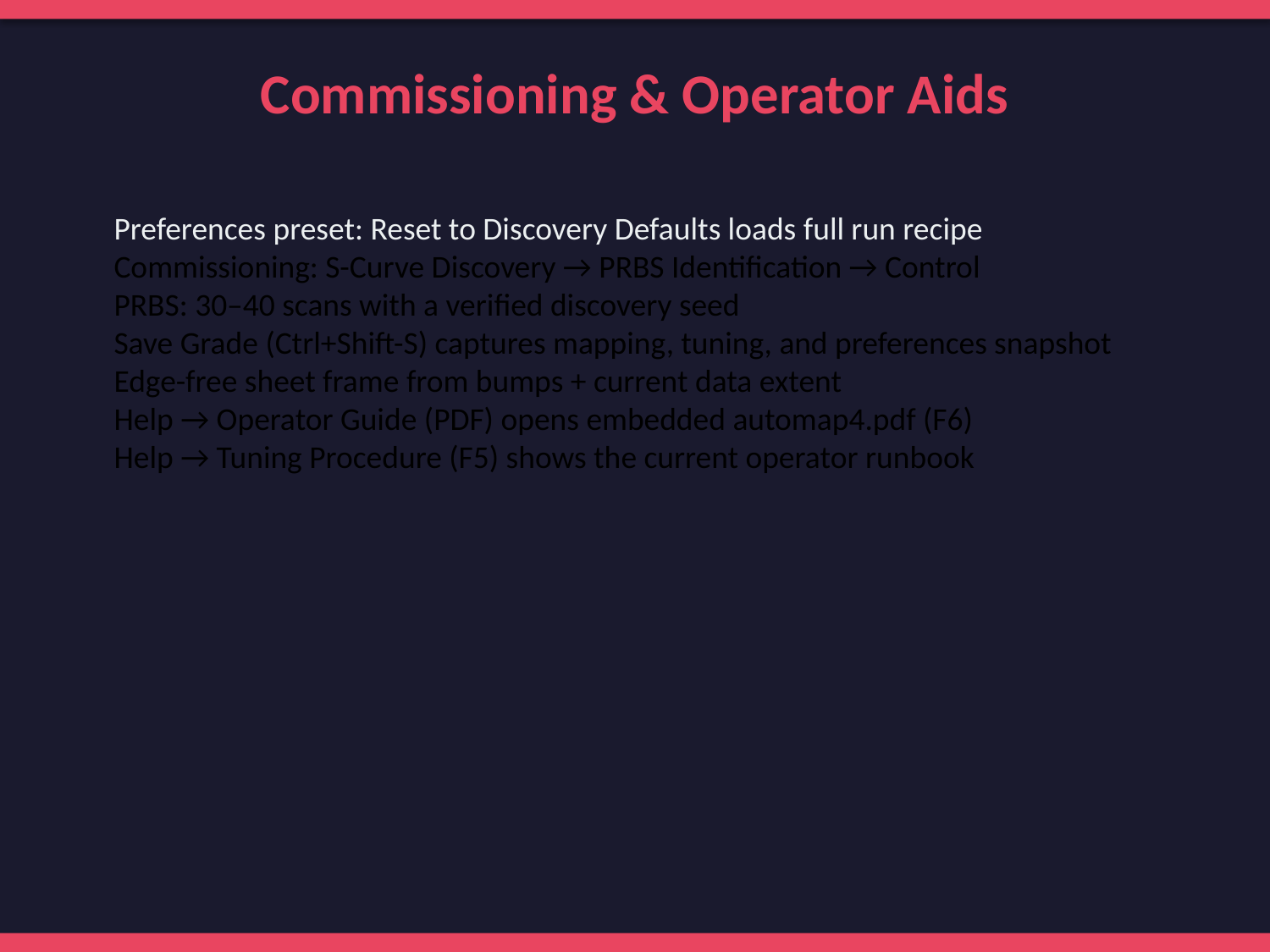
Commissioning & Operator Aids
Preferences preset: Reset to Discovery Defaults loads full run recipe
Commissioning: S-Curve Discovery → PRBS Identification → Control
PRBS: 30–40 scans with a verified discovery seed
Save Grade (Ctrl+Shift-S) captures mapping, tuning, and preferences snapshot
Edge-free sheet frame from bumps + current data extent
Help → Operator Guide (PDF) opens embedded automap4.pdf (F6)
Help → Tuning Procedure (F5) shows the current operator runbook
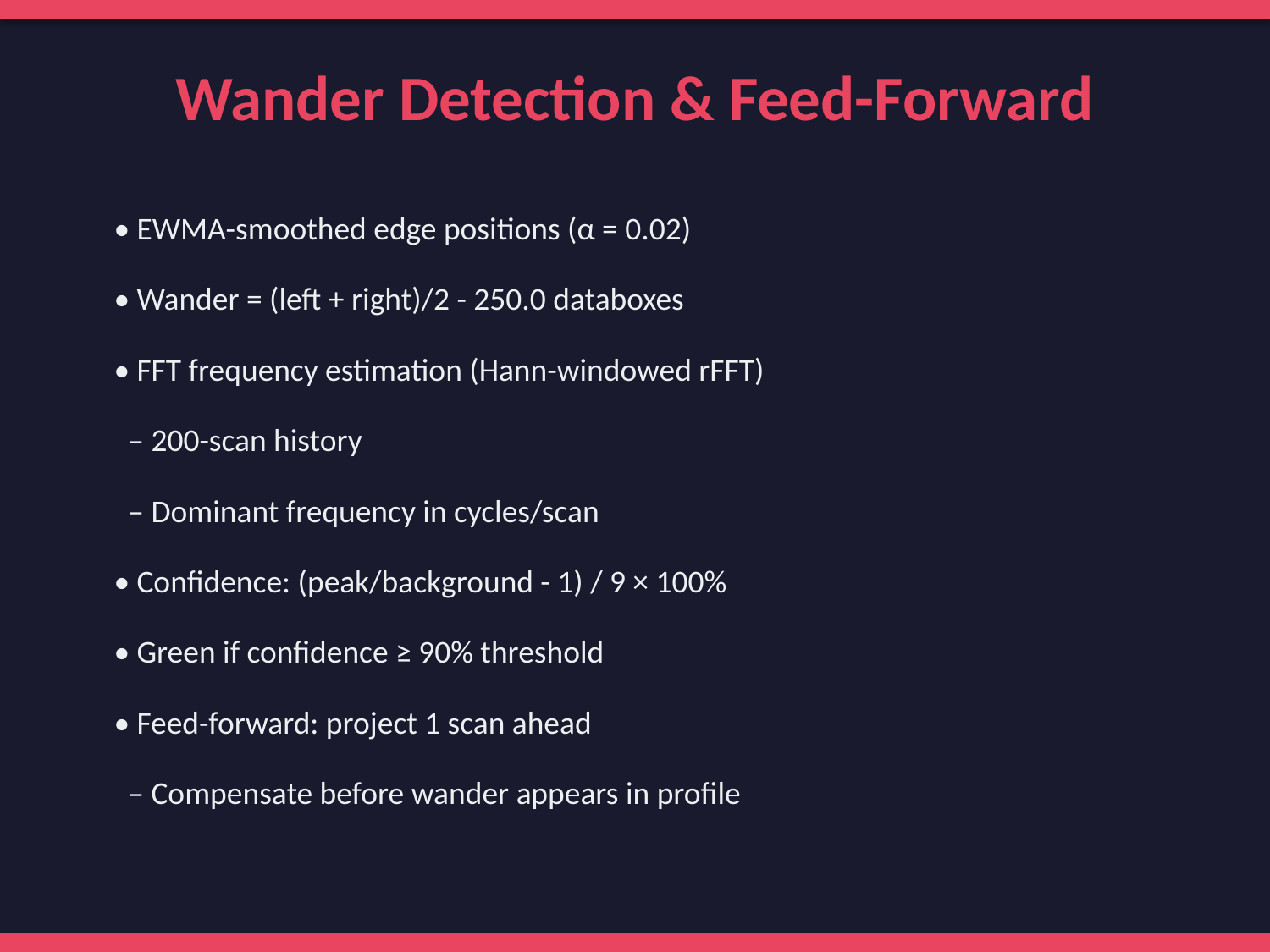
Wander Detection & Feed-Forward
- EWMA-smoothed edge positions (α = 0.02)
- Wander = (left + right)/2 - 250.0 databoxes
- FFT frequency estimation (Hann-windowed rFFT)
- 200-scan history
- Dominant frequency in cycles/scan
- Confidence: (peak/background - 1) / 9 × 100%
- Green if confidence ≥ 90% threshold
- Feed-forward: project 1 scan ahead
- Compensate before wander appears in profile
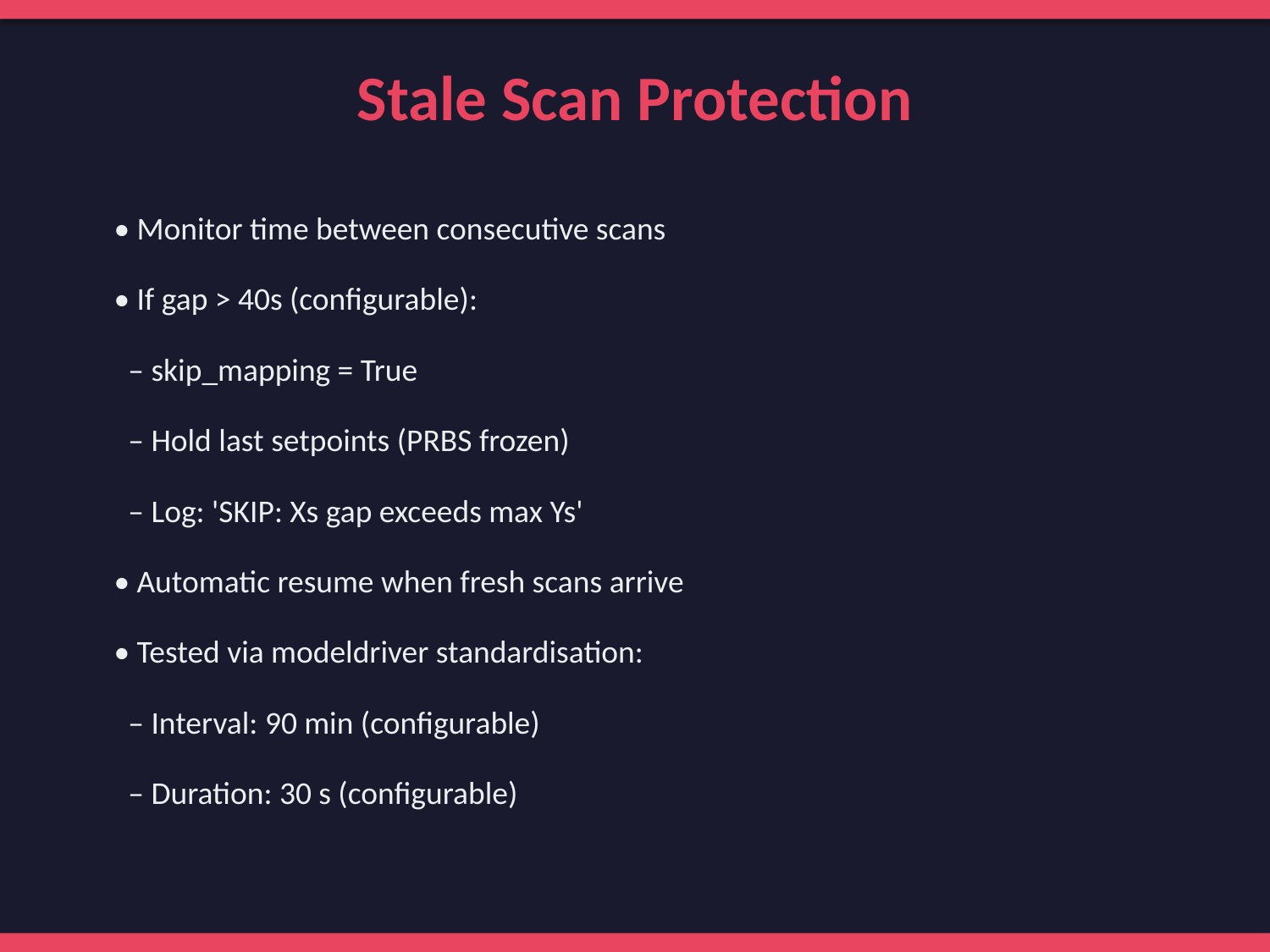
Stale Scan Protection
- Monitor time between consecutive scans
- If gap > 40s (configurable):
- skip_mapping = True
- Hold last setpoints (PRBS frozen)
- Log: 'SKIP: Xs gap exceeds max Ys'
- Automatic resume when fresh scans arrive
- Tested via modeldriver standardisation:
- Interval: 90 min (configurable)
- Duration: 30 s (configurable)
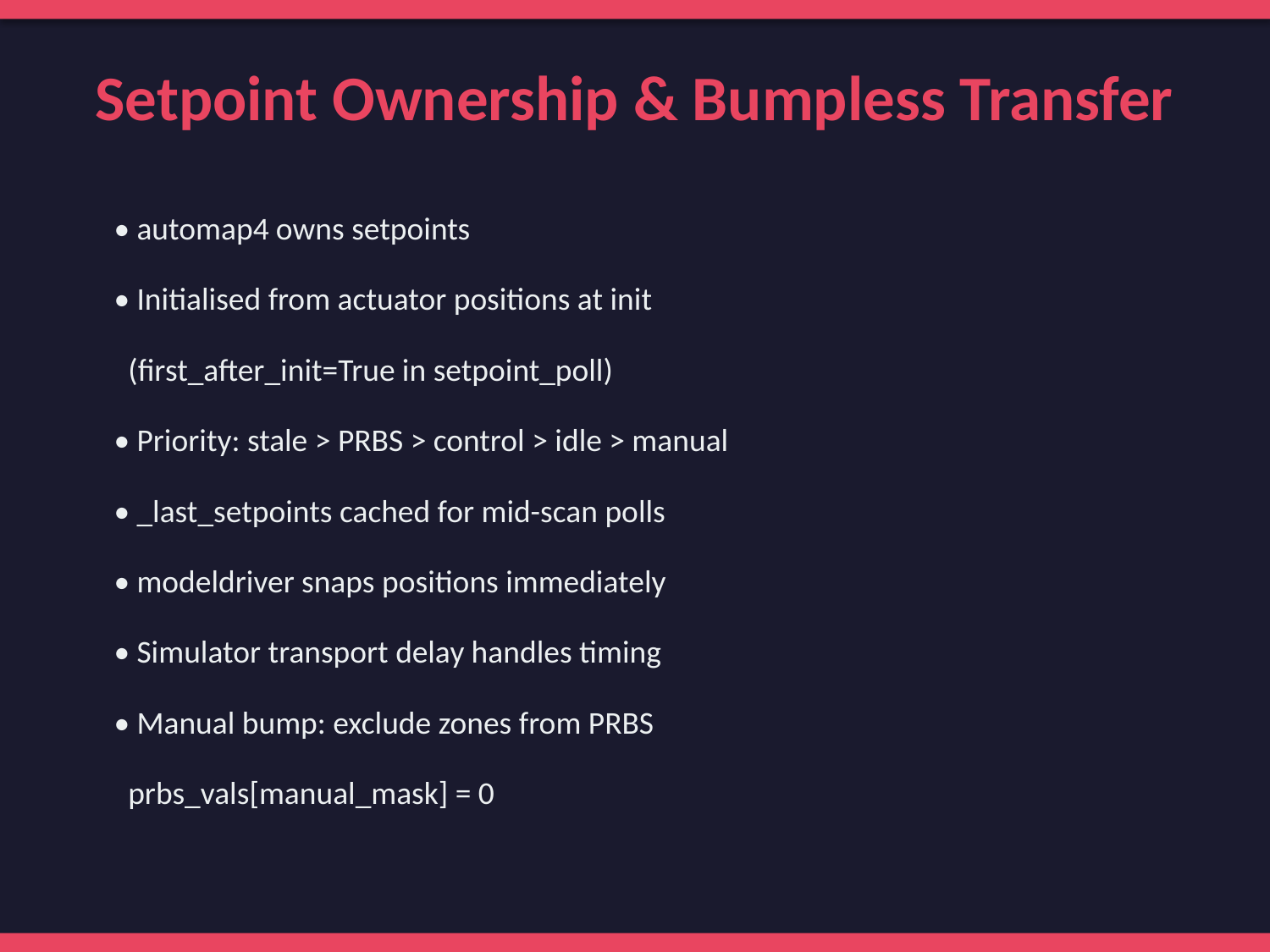
Setpoint Ownership & Bumpless Transfer
- automap4 owns setpoints
- Initialised from actuator positions at init
(first_after_init=True in setpoint_poll)
- Priority: stale > PRBS > control > idle > manual
- _last_setpoints cached for mid-scan polls
- modeldriver snaps positions immediately
- Simulator transport delay handles timing
- Manual bump: exclude zones from PRBS
prbs_vals[manual_mask] = 0
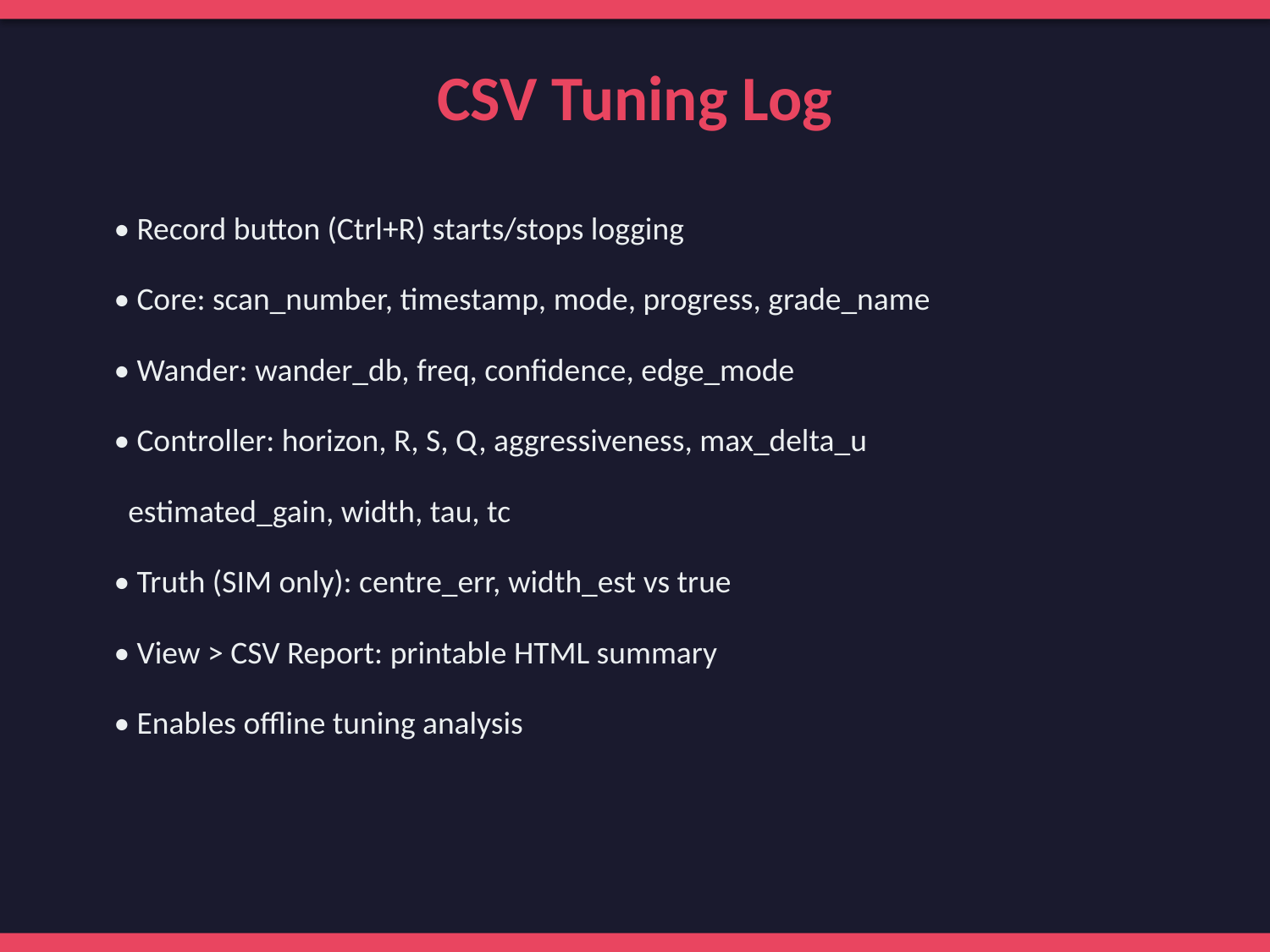
CSV Tuning Log
- Record button (Ctrl+R) starts/stops logging
- Core: scan_number, timestamp, mode, progress, grade_name
- Wander: wander_db, freq, confidence, edge_mode
- Controller: horizon, R, S, Q, aggressiveness, max_delta_u
estimated_gain, width, tau, tc
- Truth (SIM only): centre_err, width_est vs true
- View > CSV Report: printable HTML summary
- Enables offline tuning analysis
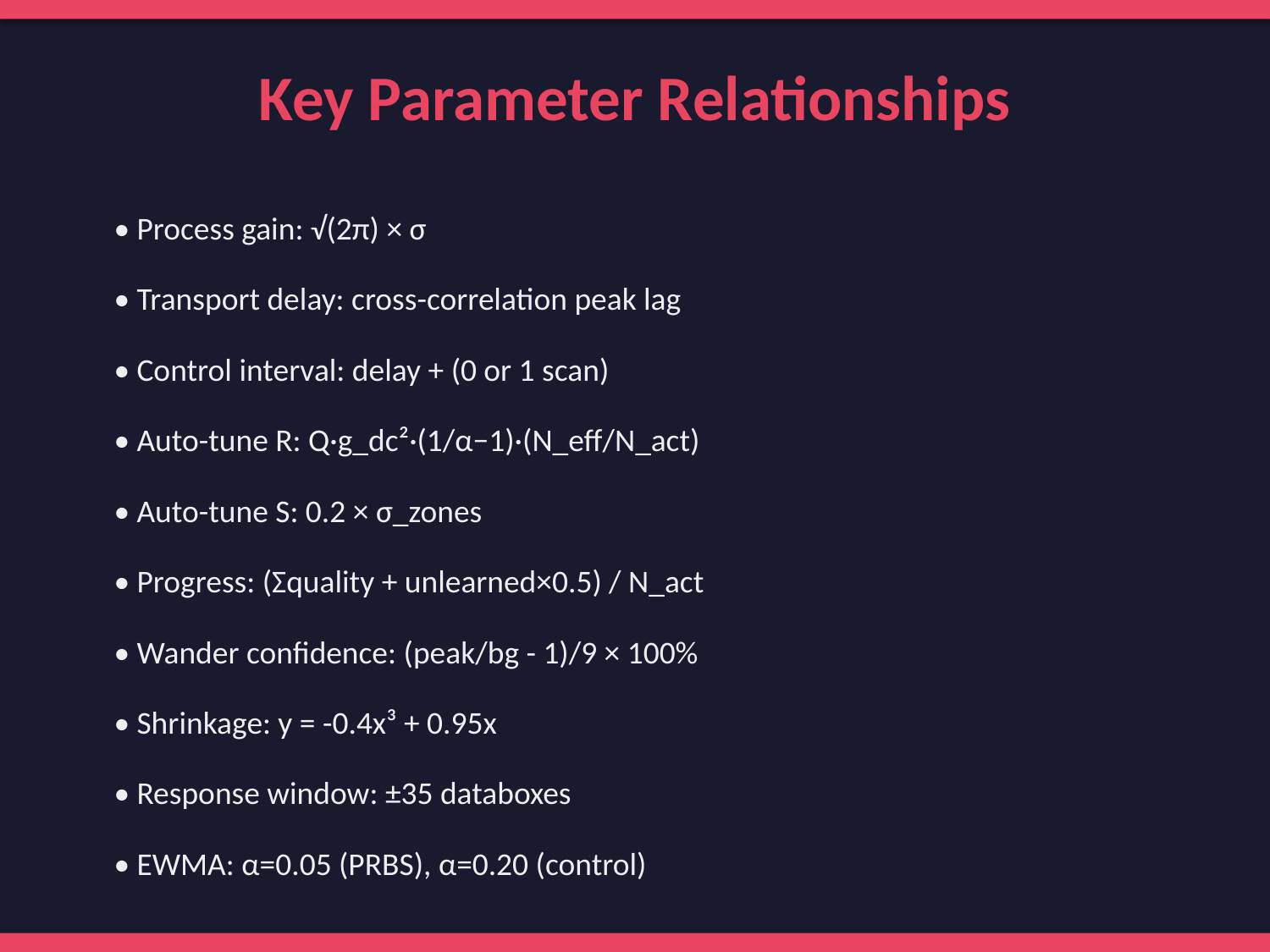
Key Parameter Relationships
- Process gain: √(2π) × σ
- Transport delay: cross-correlation peak lag
- Control interval: delay + (0 or 1 scan)
- Auto-tune R: Q·g_dc²·(1/α−1)·(N_eff/N_act)
- Auto-tune S: 0.2 × σ_zones
- Progress: (Σquality + unlearned×0.5) / N_act
- Wander confidence: (peak/bg - 1)/9 × 100%
- Shrinkage: y = -0.4x³ + 0.95x
- Response window: ±35 databoxes
- EWMA: α=0.05 (PRBS), α=0.20 (control)
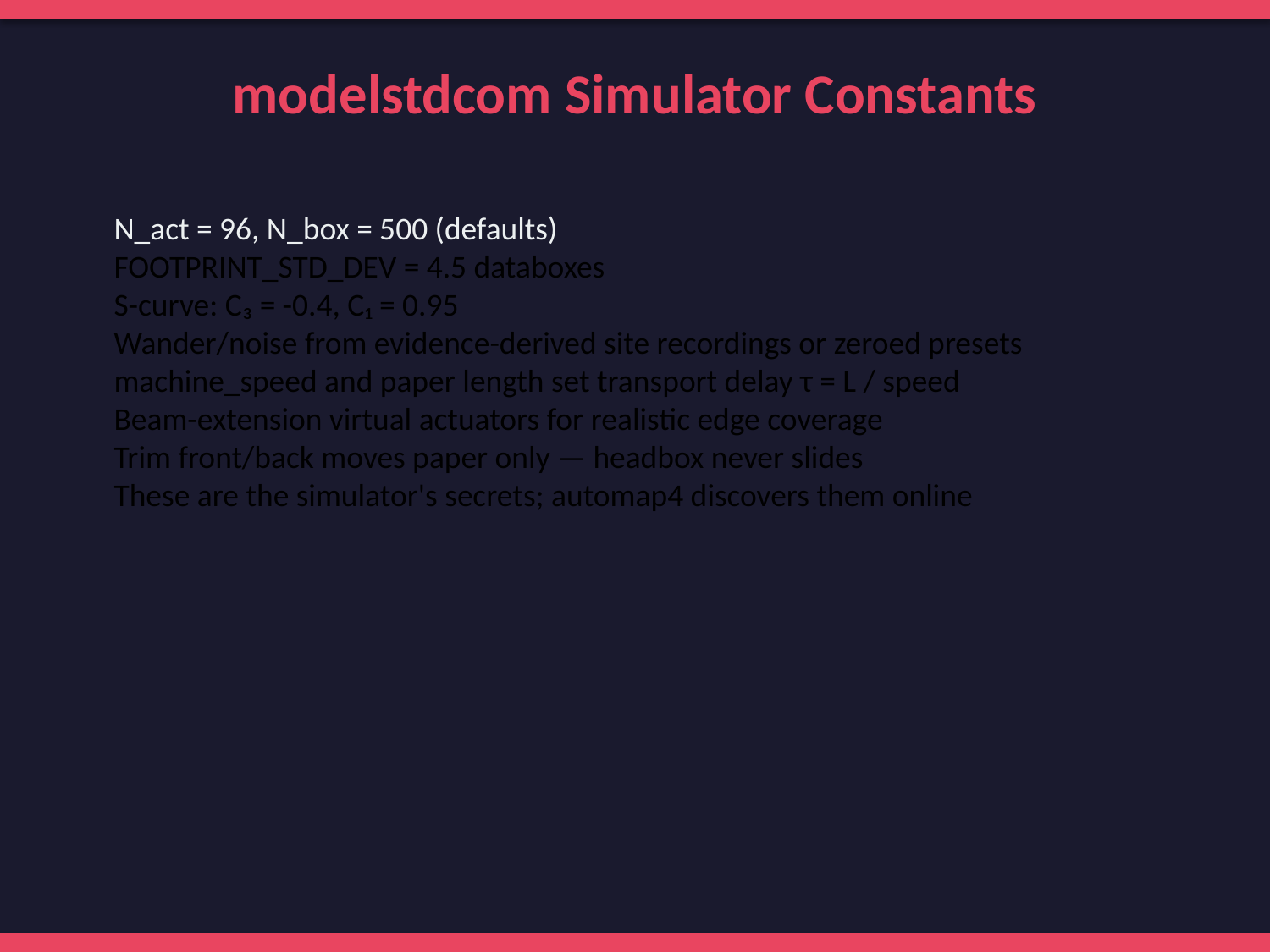
modelstdcom Simulator Constants
N_act = 96, N_box = 500 (defaults)
FOOTPRINT_STD_DEV = 4.5 databoxes
S-curve: C₃ = -0.4, C₁ = 0.95
Wander/noise from evidence-derived site recordings or zeroed presets
machine_speed and paper length set transport delay τ = L / speed
Beam-extension virtual actuators for realistic edge coverage
Trim front/back moves paper only — headbox never slides
These are the simulator's secrets; automap4 discovers them online
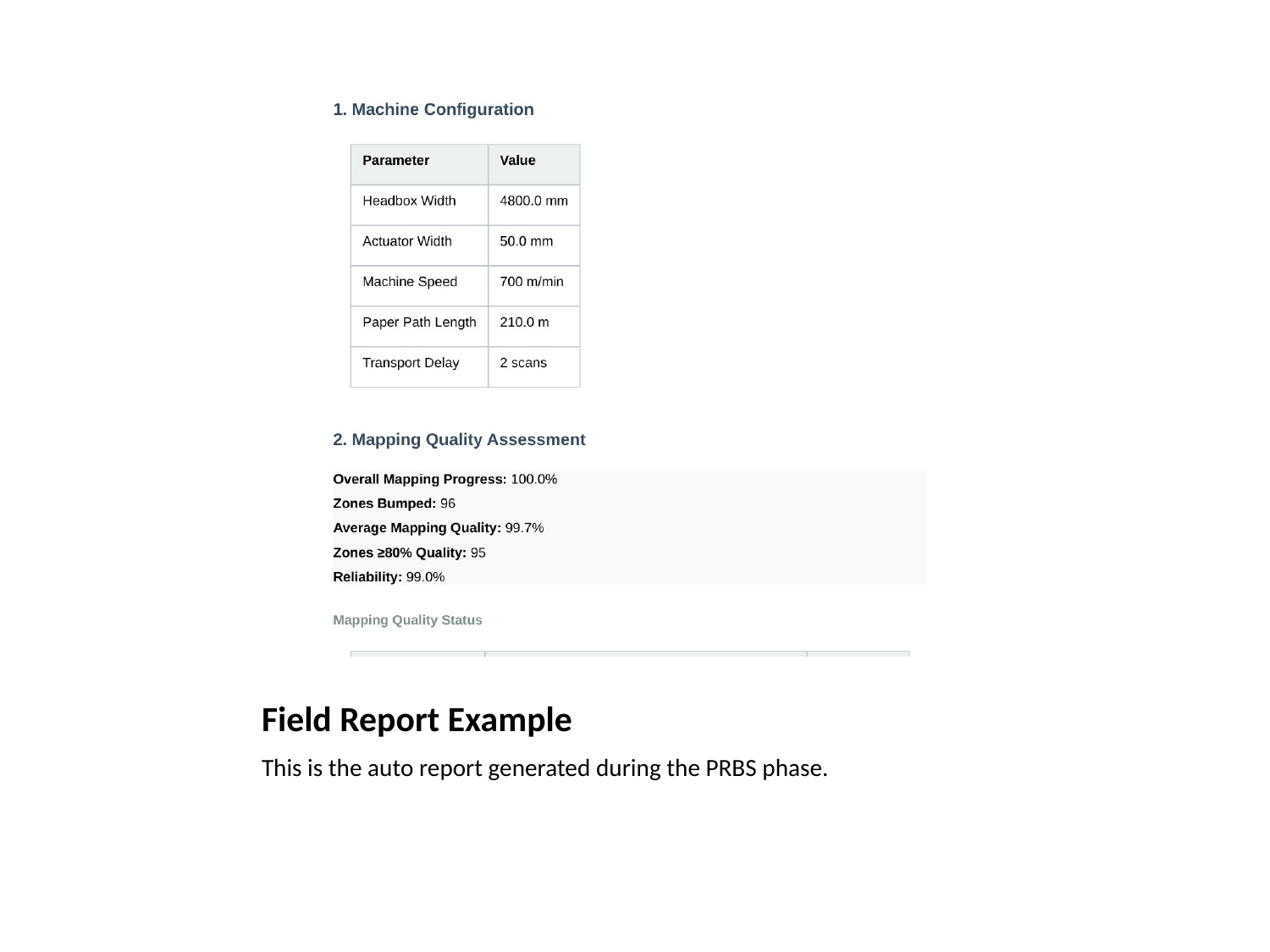
Field Report Example
This is the auto report generated during the PRBS phase.
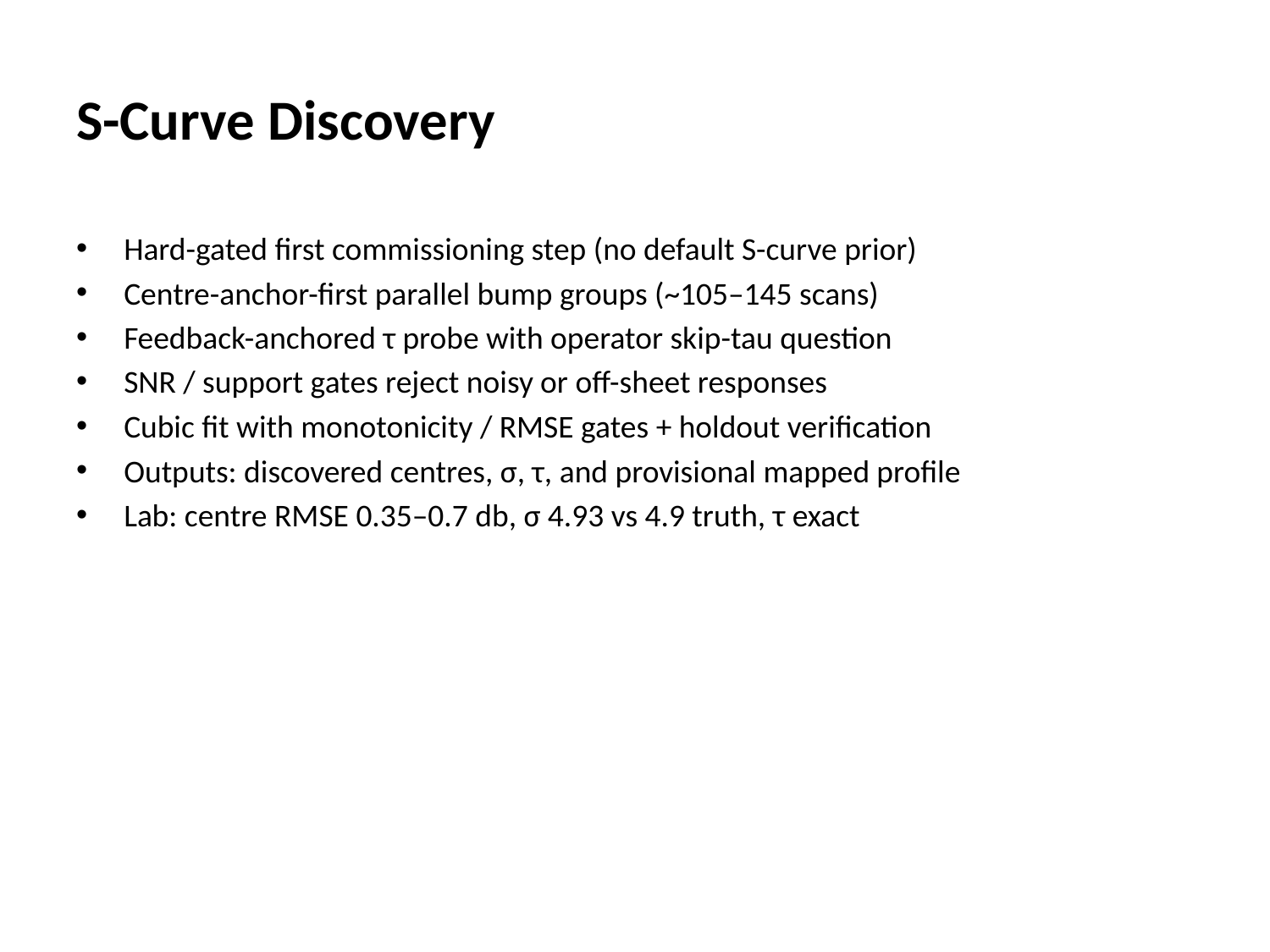
S-Curve Discovery
Hard-gated first commissioning step (no default S-curve prior)
Centre-anchor-first parallel bump groups (~105–145 scans)
Feedback-anchored τ probe with operator skip-tau question
SNR / support gates reject noisy or off-sheet responses
Cubic fit with monotonicity / RMSE gates + holdout verification
Outputs: discovered centres, σ, τ, and provisional mapped profile
Lab: centre RMSE 0.35–0.7 db, σ 4.93 vs 4.9 truth, τ exact
Edge-Free Frame & Paper-Aware Profiles
Sheet frame from bumps + current non-zero data extent (edge-free)
Identity ruler 0..N-1; scanner edges are display-only
A 0 databox means no paper — never treated as 0 g/m²
Off-sheet zones are pinned: no error, no gain, no move
Trim front/back narrows the mapped profile; headbox stays fixed
Mapped profiles (.prbs / .simple) computed over paper only
Optional actuator-anchored frame tracker for sheet wander
Actuator Level & Bumpless Transfer
CD control never sets the array mean — it is a free variable
Every control move is zero-mean over counted zones (on paper, not manual)
Counted mean walks toward Preferences → Actuator target level (%)
Maximum walk per move = Level ramp step (%/move)
Bumpless transfer at control enable: level seeds from current mean
Manual zones and off-sheet zones are excluded from level counting
Toolbar readouts: Act level (amber while ramping, green on target)